
Key Takeaways:
- Creators reshape Olympic coverage
- Niche audiences beat mass reach
- Authenticity drives fandom
- Athletes as lifestyle storytellers
If you’ve been following the Olympics this year, you probably noticed something different.
Yes, there are still sweeping drone shots over snow-capped mountains. Yes, there are primetime recaps, slow-motion replays, and commentators with perfect diction. But during those moments, you’re also seeing some awesome Olympic and Paralympic creator-led coverage on your second-screen devices.
This year, creators are following Olympic and Paralympic hopefuls and bringing fans (new and old) into spaces traditional broadcast cameras rarely reach. This fun content lives on creators’ individual channels and brings a unique flair to every moment.
We saw hints of this in Paris. YouTube reports that during the 2024 Games, its content reached 12 billion views from more than 850 million viewers, with much of it driven by creator coverage. But in 2026, brand sponsors and creators are leaning in even more, making the scale bigger and the access deeper.
In this article, we’ll look at how creator-led coverage in Milano Cortina is unfolding and how it acts as the perfect case study in how brands can succeed when audiences follow creators first and platforms second.
1. Brands can tap into niche audiences with creator partnerships
There’s no wider audience than the Olympics. It’s one of the only events made for the citizens of the entire world.
But it rarely makes sense for brands to broadcast their message to “everyone in the world,” especially when hundreds of thousands of niche audiences tune in daily to niche creator-led spaces.
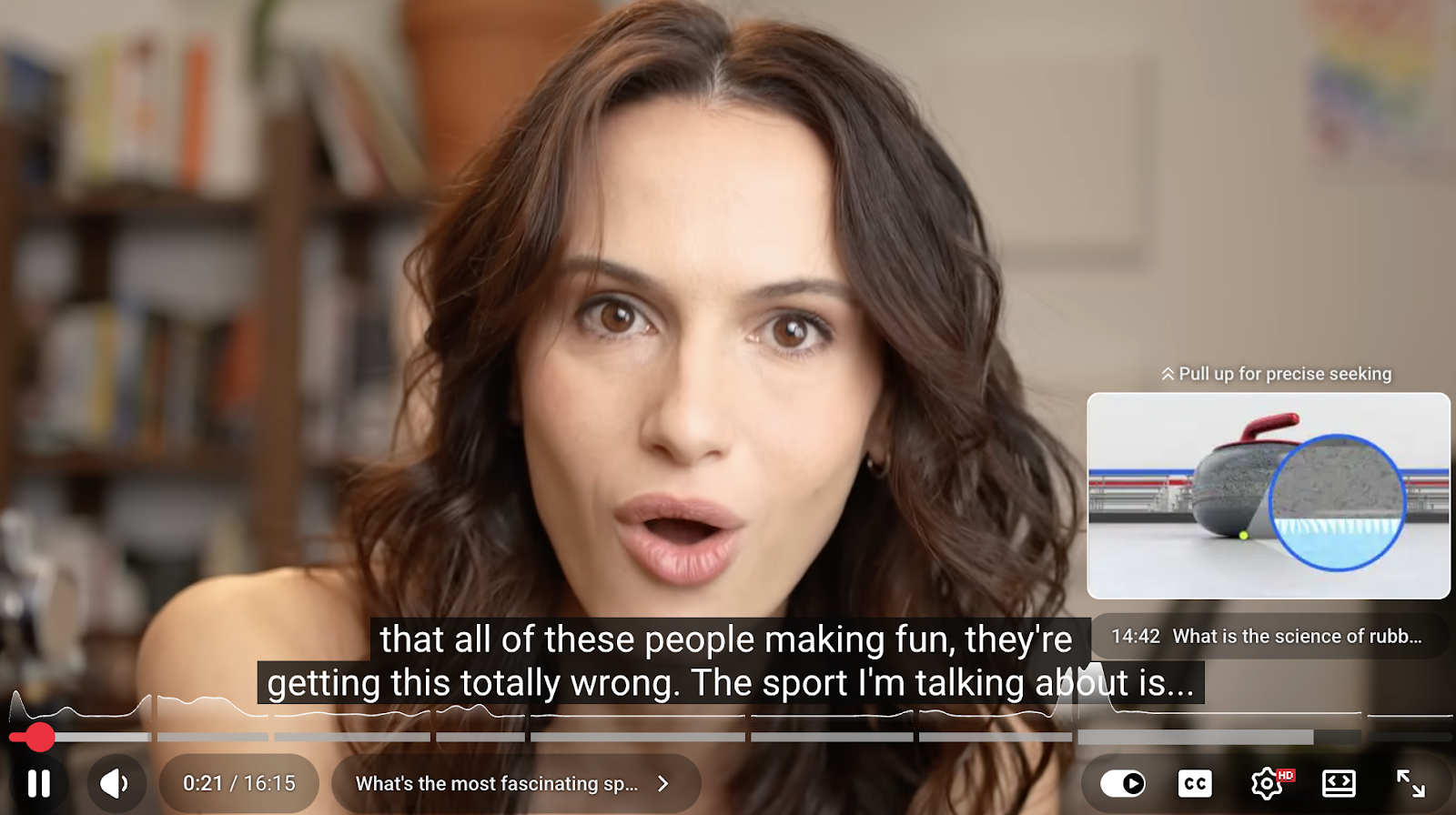
NBC gets this and leaned into creator partnerships hard this year. Instead of hiring one broadcaster to make generalized statements about Olympic events, NBC cast a much wider net. In the curling event, specifically, they partnered with Cleo Abram for unique coverage.
Cleo is an Emmy-nominated video journalist and the host of Huge If True, a science and technology show with more than 7 million subscribers. Her audience consists of science-curious viewers, tech enthusiasts, students, engineers, and generalists who enjoy understanding how things work. Many people subscribe to her channel for the intellectual payoff.
And that’s exactly what Cleo brings to the event. With access to the Olympic Trials, Cleo produced a 16-minute investigation exploring the chemistry of granite quarried from a single Scottish island. She walks through the mechanics of sweeping and ice pebbling. She revisits “Broomgate” and equipment regulation. She dives into the unresolved physics question of why curling stones curl in the same direction they spin, connecting tribology to glacier movement, vehicle safety, and planetary exploration.
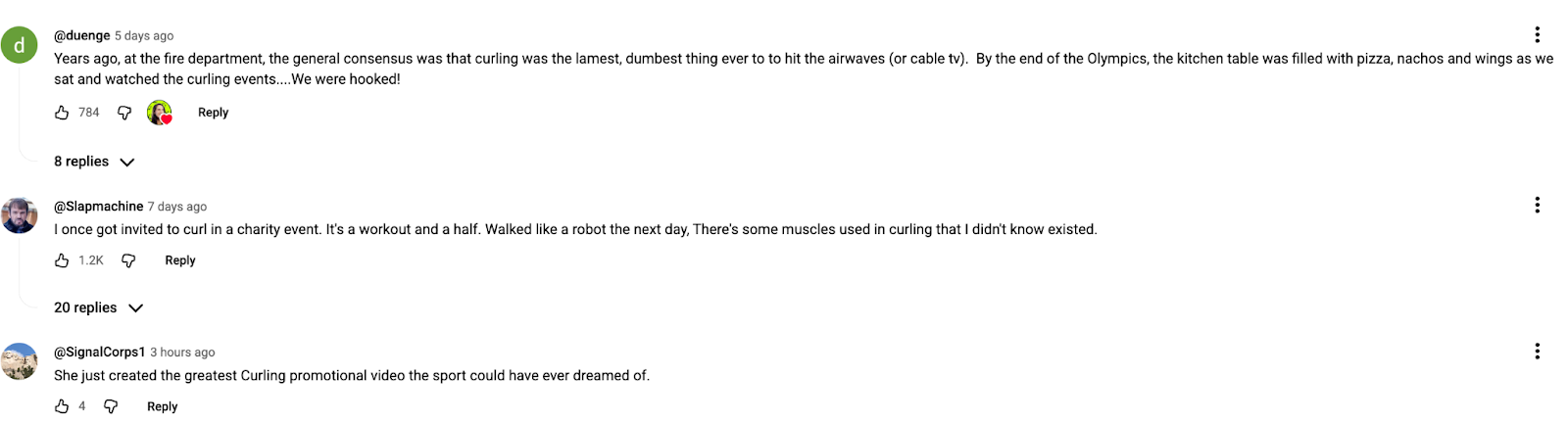
And her viewers eat it up. Take a gander at the video’s comments as proof. One viewer says, “I've never heard of this curling sport before. But after hearing all the fascinating strategies and physics behind it, I immediately got obsessed with it.”
Another said, “I saw curling for the first time in the last Olympics and wondered, ‘Why is this in the Olympics?’ … Now, I have clear information… I hope the mysterious physics are resolved soon.”
Several other viewers weigh in, too:
There’s a lesson for brands here, especially for brands with niche audiences. You don’t need to pay for a multi-million dollar ad spot to participate in the games. Instead, tap into creator-era Olympic coverage. Partner with a creator who your audience loves and give them the floor to bring your brand to the forefront.
2. Brands can reignite dormant audiences through creator partnerships
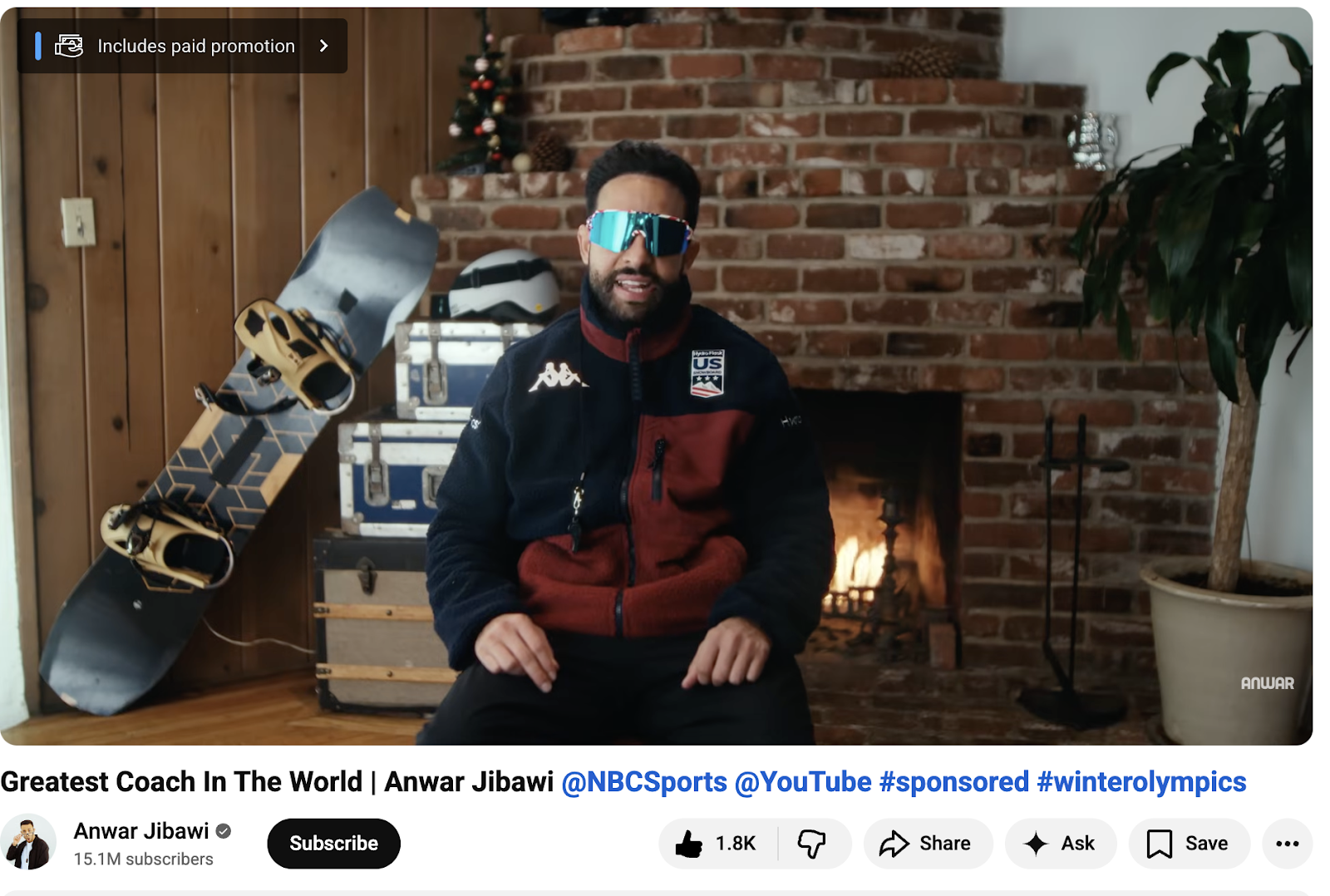
Anwar Jibawi has 10+ million YouTube subscribers, hundreds of millions of views across shorts and sketches, and a loyal fanbase built on absurdist, character-driven comedy. But lately, he’s been quiet. We haven’t seen any new videos or viral sketches for months.
That pause made his reappearance (at the Olympics of all places) a total joy. He popped up on the snowboarding slopes as the self-declared “greatest coach alive,” in a parody sketch produced by NBC that immediately grabbed attention.
It’s another smart move by NBC. Instead of hoping people will tune into NBCSports, they targeted a community they knew would be waiting—Anwar’s fans. His audience clicked because he showed up in their feed again. And once they did, NBC didn’t have to chase attention, because it was already there.
What’s more, his parody sketch hits all the right notes to keep people watching. In the video, Answer is a confident but clueless coach who licks the snow to “test the conditions,” shouts contradictory advice mid-run, and throws around snowboarding lingo like it’s an improv game (“faster!… now slower!”).
The video is the farthest thing from sports casting. (It’s more like sketch comedy dressed up in Olympic drag). But that’s what makes it work. Most Olympic content is structured to inform or inspire. Anwar’s bit exists purely to entertain. It’s a fun way to draw a new audience in and invite them to stay for the rest of the show (with no pressure to understand qualifiers or competitive circuits).
3. Creators can lead their audience to new fandoms
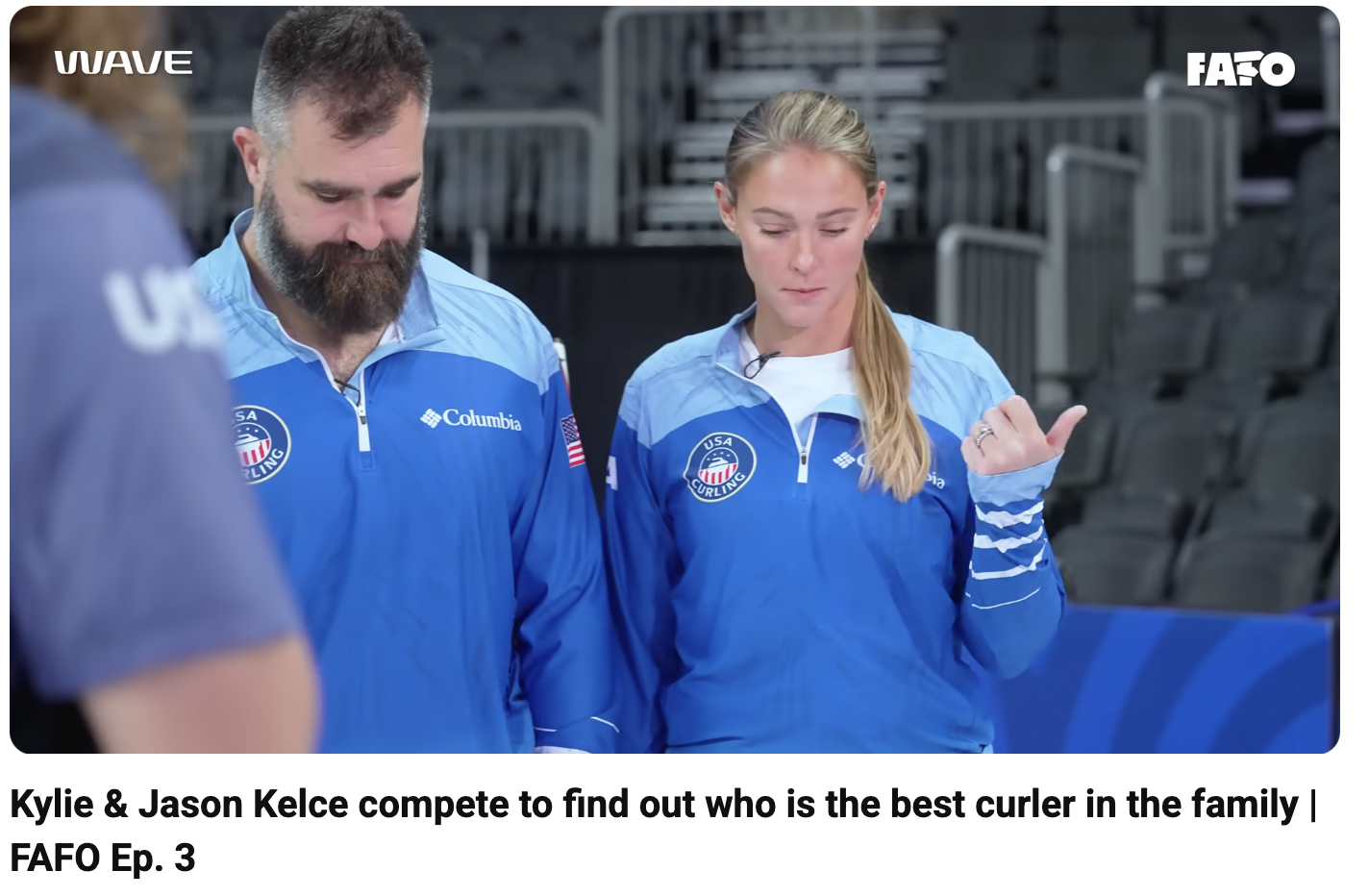
The next example takes us back to curling. In a special “FAFO” (F*** Around, Find Out) episode, Kylie and Jason Kelce hit the ice for the first time with Olympic gold medalists as their coaches.
The whole thing is produced by YouTube and NBC, and it feels like a crossover event in the best way. To sum up the video in a short sentence, it’s podcast energy meets creator energy meets sports documentary chaos.
In the video, the Kelces are doing what they do best. They’re chirping at each other, cracking jokes, wiping out on the ice, and slowly figuring out how to throw a 42-pound stone with some dignity.
In between the laughs, something sneaky happens. Viewers learn the mechanics of curling, including why the stones curve, how sweeping affects speed, and what curling strategy looks like. It’s bite-sized Olympic education delivered by two creators people already know and trust.
By the end, viewers are still Kelce fans, but they’re also Olympic curling fans (which is exactly the win that NBC wants).
This example is a perfect reminder that while audiences may often be niche, they aren’t exclusive to that niche. They’ll follow their favorite voices to learn about new things, whether it's an Olympic sport, a new lip gloss, or even a new car insurance plan.
This is the magic of creator-brand partnerships that brands can apply to any campaign.
4. Personal storytelling and creator authenticity still win hearts (and new fans)
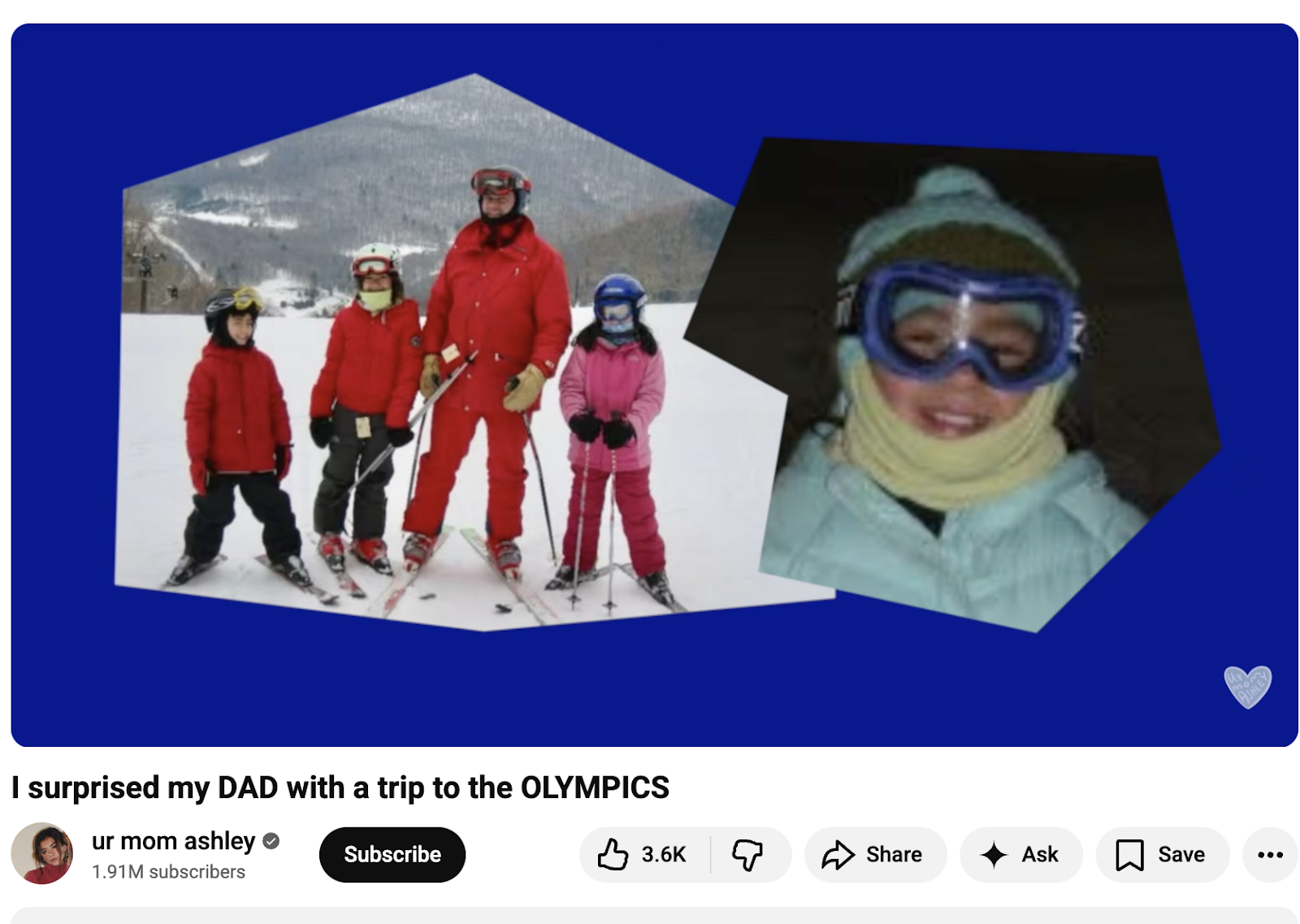
Next up, we have a new take on Olympic coverage that uses an old-school creator marketing trick. In this video, a beloved (to the tune of 1.91 million subscribers) creator surprises her ski-loving dad with a trip to the Olympics.
In this YouTube x NBC segment, @urmomashley brings her dad, an ex-college ski team member and lifelong Olympic fan, to Cortina for a once-in-a-lifetime experience.
It’s a personal gift turned public content moment, where viewers follow along as he reacts to every detail, from the airport to the official jacket drop.
It lands well because it’s raw, authentic, and focused on the personal storytelling that so many people crave right now, especially in the age of AI.
If the story isn’t enough to convince us that leaning into authentic storytelling is the right move, the data can.
Stats show 88% of consumers say authenticity is non-negotiable when deciding what brands they support. And Sprout Social reports that 77% of people are more likely to engage with content that feels genuine and relatable. When audiences feel like they’re being let into something personal, attention follows.
5. Brands can partner with the athletes themselves
There’s a fine line between hiring a celebrity or, in this case, a widely known athlete for a sponsored slot. But when the celebrity is highly relevant to the event, it’s a great idea.
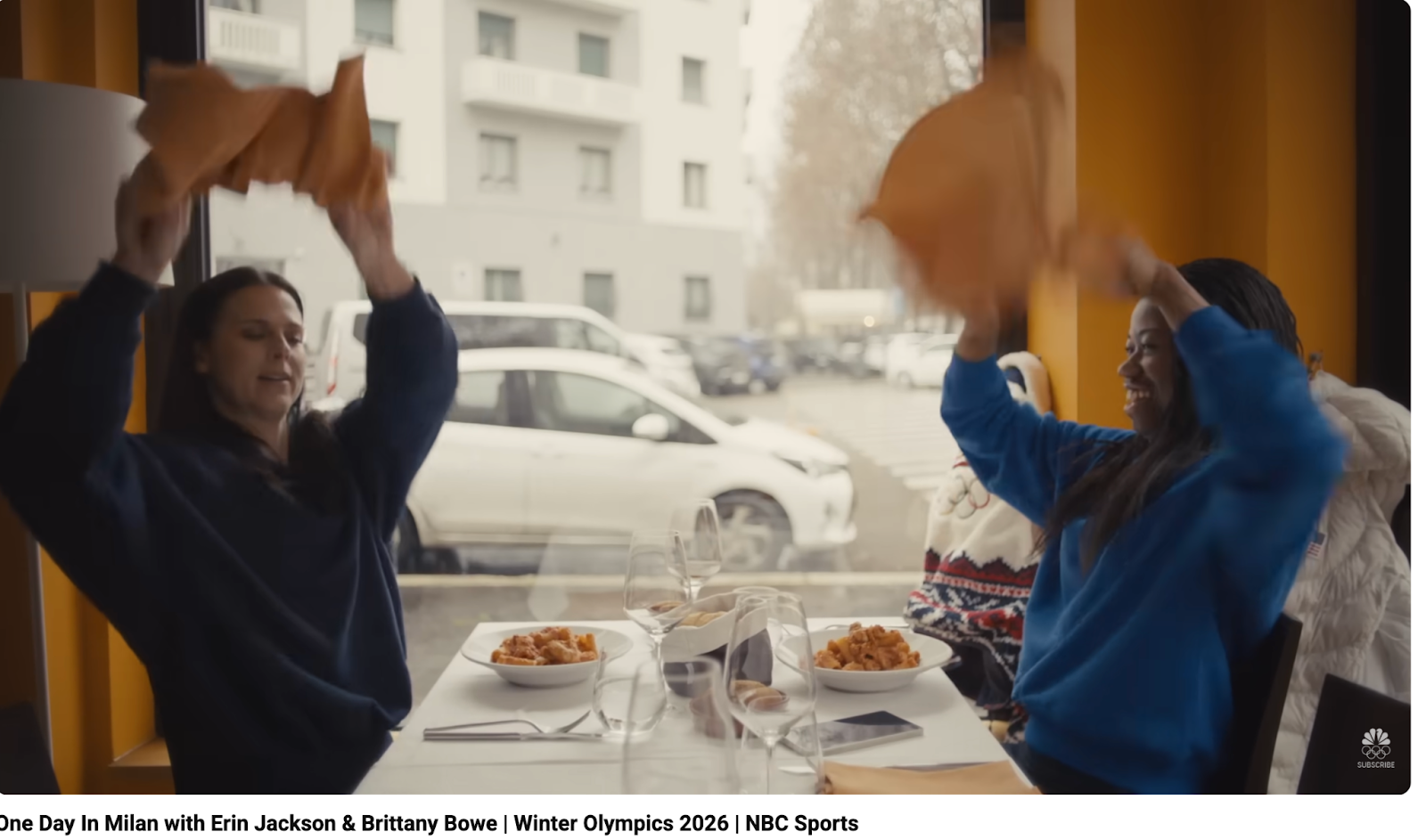
In one fun YouTube segment, NBC partners with Olympic speed skaters Erin Jackson and Brittany Bowe, but not in a way you may expect. They’re not racing. In fact, they’re not even in uniform, and no skates are in sight.
The two skaters are on a pasta tour in Milan, laughing at dishes they can’t pronounce, asking Google for “the most unusual ingredients,” debating whether breaking spaghetti should be illegal, and reacting in real time when they realize they just ate intestines.
It feels a bit more like YouTube travel content led by some of America’s most impressive athletes. And it gives us a glimpse into the personalities of Jackson and Bowe. It’s fun to watch how dynamic, fun, relatable, and human they both are.
For brands, a partnership like this is a fun opportunity. Athletes already carry attention and have a following. But when they’re only shown competing, that connection stays transactional. We cheer for them during the event and move on.
With a video like this, we become emotionally invested. We want to learn more about them. We want to see them win. And where do we click to go see more of their Olympic content? Right on the NBC link that’s sitting under the video.
The big takeaway: People follow people over programming and brands. If you want to draw attention to your network or brand, partner with the creators people already love and follow.
%20(1).png)
.png)
.png)