
Key takeaways
- Paid media means buying advertising placement or distribution; organic content reaches people without paying the platform to distribute that post.
- Brands can use paid media to support awareness, consideration, leads, and sales, with different measures for each objective.
- Creators can advertise their own businesses or license content for brand campaigns under agreed commercial terms.
- Paid distribution becomes more relevant when a defined audience, deadline, or business goal calls for a funded campaign.
- Organic content remains valuable for discovery, conversation, and learning what audiences find useful.
A creator publishes a product demonstration. Viewers ask where to buy it, tag friends, and describe how they might use it. The brand sees an opportunity but its launch promotion ends next week, and the post’s next wave of viewers is uncertain.
That’s where paid media enters the conversation. An advertising budget gives the brand another way to distribute the content, with choices about its audience, timing, and intended outcome.
The decision involves more than making a post bigger. Paid media can support discovery, customer acquisition, or a creator’s own business. Its value depends on what needs to grow and whether additional distribution can help.
What paid media actually means
Paid media is advertising placement or distribution purchased by an advertiser. It includes paid search, social advertising, display ads, and video advertising, among other formats. For brands working with creators, paid social is a particularly relevant application.
A brand might promote an existing post or run an ad made specifically for a campaign. In either case, the advertiser funds delivery through the platform.
Organic content follows a different distribution model. A brand or creator publishes without paying the platform to distribute that particular post. Followers, recommendations, search, and sharing can all contribute to discovery.
Organic content can reach well beyond an account’s followers. It also requires investment in ideas, production, and community management. The distinction concerns the purchase of distribution, rather than whether the content costs anything to produce.
There’s another distinction within creator partnerships: paying a creator and buying advertising distribution are separate expenses. A creator fee may cover production and publication. Permission to advertise with that content and the media budget itself depends on the agreed scope.
How paid media can support brand growth
Growth can begin with someone discovering a brand, understanding a product, or becoming ready to buy. Paid media can support each of those stages, although the campaign’s objective changes what a useful result looks like.
An unfamiliar product may need explanation before the audience considers purchasing. A creator’s demonstration can make its use more understandable. Paid distribution gives the brand a way to bring that explanation to additional prospective customers.
For a business seeking inquiries or sales, the opportunity also depends on what happens after the ad: the offer, destination, availability, and customer experience.
IAB’s 2025 Creator Economy Ad Spend & Strategy Report reflects this range of intentions. Its published findings identify brand awareness and new-audience reach among the leading creator-campaign goals, while 32% cited driving online sales or conversions. Those figures describe advertisers’ objectives, rather than guaranteed campaign results.
The growth case therefore depends on the assignment. An awareness campaign may contribute by introducing the brand to relevant people. An acquisition campaign needs evidence about the customers or qualified actions associated with the investment.
What paid media offers creators
Creators can participate in paid media as advertising partners and as business owners.
In a brand partnership, a creator may produce content that the advertiser licenses for paid use. The potential commercial value extends beyond the original post, depending on the agreement’s formats, duration, markets, and compensation.
TikTok’s Spark Ads illustrate how that relationship can work. Brands can advertise using an authorized creator post, with engagement generated through promotion attributed to the original post. That provides a connection between the advertising activity and the creator’s published content, without guaranteeing lasting audience or revenue growth.
Creators can also buy advertising for their own businesses. A creator selling a course, offering a service, or launching a product has a different objective from one seeking more profile visits. TikTok’s Promote tool, for example, offers objectives covering account visibility, leads, and sales, subject to the relevant requirements.
The business question remains the same: what does the additional exposure contribute? A larger audience may support future opportunities, while a creator selling a product also needs to understand customer acquisition costs and the economics of the sale.
When paid media makes sense and when organic deserves more room
The choice depends on what the brand or creator needs the content to accomplish.
Paid distribution becomes more relevant when there is a specific audience, a time-sensitive opportunity, or a defined action worth funding. Organic activity remains useful when the priority is sustained conversation, creative exploration, or understanding audience needs.
These are planning considerations, rather than fixed rules: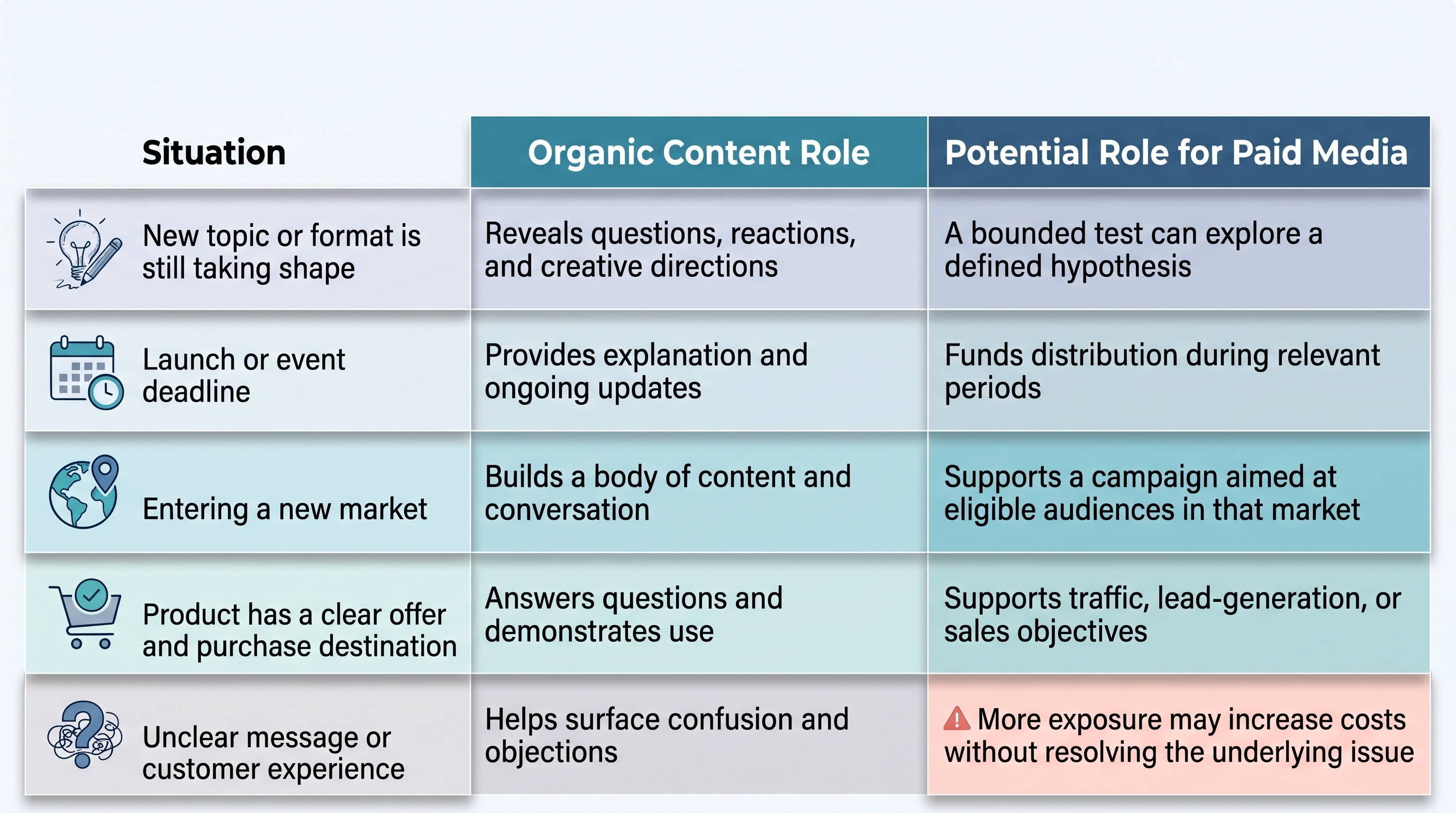 A paid campaign can be justified before a post becomes popular. A modestly viewed demonstration may explain the product clearly and suit a particular audience. Conversely, a widely shared joke may have little connection to what the advertiser sells.
Organic response provides context for the decision. It doesn’t settle the case for investment.
Paid and organic content can contribute to the same growth plan
Consider a hypothetical skincare creator explaining how a product fits into a routine. Organic comments reveal that viewers are confused about when to apply it. A follow-up addresses that question.
The brand now has a clearer explanation that could suit advertising. Paid distribution could introduce it to another audience, while organic activity continues answering questions and developing the topic.
There are documented examples of this connection. The 2024 Ipsos and TikTok Return on Creative whitepaper described Booking.com using comment analysis and content-performance information to inform its organic-to-paid strategy and spending decisions. The case illustrates how audience feedback can inform amplification; it does not establish a universal financial return.
The useful relationship runs in both directions. Organic conversations can suggest advertising ideas. Questions arising during a campaign can reveal what subsequent content needs to explain.
How to tell whether paid media is contributing to growth
The evidence needs to match the reason for spending.
For awareness, that may involve relevant reach and suitable brand-lift measures. For lead generation, inquiry quality matters alongside volume. For sales, the assessment involves revenue, customer acquisition, margins, and campaign costs. More views establish that the content received more exposure. They don’t, on their own, establish profitable growth.
The wider investment may include creator compensation, usage rights, production, editing, and campaign delivery alongside media spend. Attribution also has limits: sales credited to a campaign are not necessarily all additional sales caused by it.
Viral Nation’s Business Intelligence services connect business objectives with attribution, lift studies, and analysis to inform investment decisions.
That gives evaluation a practical purpose. The team can assess whether another campaign, a different message, or continued organic development offers the stronger next opportunity.
The decision starts with what needs to grow
Paid media gives a brand or creator a funded way to pursue additional exposure and business outcomes. Organic content supports the continuing work of being useful, discoverable, and responsive to an audience.
At Viral Nation, paid media services connect creator-led amplification with audience strategy, testing, optimization, and measurement.
The case for advertising becomes clearer when the message has a purpose, the intended audience is understood, and the business can explain what a worthwhile result would mean. Sometimes the next investment belongs in distribution. Sometimes the content or customer experience needs more development first.
Frequently asked questions
What is the difference between paid media and organic content?
Paid media involves buying advertising placement or distribution. Organic content reaches people without paying the platform to distribute that post, although producing and managing it still involves time and cost.
When does paid media make more sense than organic posting alone?
Paid media can suit a defined audience, deadline, or growth objective that calls for an advertising budget and delivery plan. Organic content remains useful for ongoing conversation, discovery, and learning what audiences respond to.
Can creators use paid media to grow their own businesses?
Creators can advertise their own products, services, or content, depending on platform eligibility and available objectives. They can also license content for a brand's advertising; the commercial terms determine how they are compensated.
Does a post need to go viral before a brand promotes it?
A post does not need viral reach to be considered for advertising. Its message, audience relevance, available permissions, and fit with the campaign objective can provide a reason to test it with paid distribution.https://ads.us.tiktok.com/resources/help/article/spark-ads?redirected=2