
Key takeaways
- Social content can appear among AI citations, but its representation varies by platform, topic, and the questions being asked.
- Creator reviews, expert commentary, and community discussions can provide useful context beyond a brand’s own website.
- Give creators and experts approved facts and supporting evidence while preserving their independent voice and judgment.
- Track mentions, cited sources, answer accuracy, and referral activity over time without treating visibility as proof of business impact.
Most marketers already understand the basics of GEO: create useful, authoritative content, answer specific questions clearly, strengthen technical foundations, and earn credible third-party mentions.
What’s less obvious is how much social content can shape what AI platforms cite and surface, especially when searchers ask AI for recommendations, comparisons, and opinions.
Tinuiti’s Q1 2026 analysis found that social media accounted for more than 9% of AI citations overall, with even higher shares on some platforms. Social sources made up 13% of Google AI Overview citations and 31% of Perplexity citations in January 2026. These figures describe Tinuiti’s tracked commercial prompts across nine categories; its aggregate gives each studied AI platform equal weight.
Those signals can come from several places, including creators, customer reviews, community conversations, and brand social content.
The practical task is to understand where these sources appear in answers to your buyers’ questions, then coordinate content, social, creator, and communications work around accurate, useful information.
Where social and third-party content appears in AI answers
1. Creator commentary
First-person reviews can provide specific product experiences and comparisons relevant to buyer questions, such as “Which one is better?”, “Is it worth it?”, or “What should I buy?”
But before building a full-blown creator strategy, it’s important to understand that AI engines don’t pull creator commentary equally from every social platform, and some platforms may not show up on AI engines at all.
YouTube is one platform worth evaluating. A 2026 analysis of more than 1,000 YouTube videos cited across AI engines found that YouTube accounted for more than 5% of all citations in the dataset. More importantly, 85% of the highest-cited videos used a comparison, ranked-list, or testing format, and “I tested” videos had the highest average citation rate of the title formats analyzed.
The analysis describes patterns among the sampled videos; it does not establish a formula for earning citations. A creator who tests several products, names the brands, explains the differences, and makes a recommendation is producing the kind of evidence an AI engine can pull into a comparison answer. In the same study, highly cited transcripts averaged 5.4 named products or other entities, compared with just 0.8 in the lowest-performing group.
Rocketblue found cited videos from both small and large channels. That observation does not establish that subscriber count has no effect. Use the study’s format patterns as ideas to test against your audience’s questions, rather than as a formula for earning citations.
2. Customer reviews and community commentary
Reddit discussions appeared frequently in the citation datasets examined here, although their prominence varied across AI platforms.
Semrush analyzed 248,000 Reddit posts cited across ChatGPT, Google AI Mode, and Perplexity and found Reddit among the top three cited domains on all three platforms. More than half of the Reddit citations came from Q&A threads, while comparison and discussion posts were also common. These 3 formats accounted for nearly three-quarters of cited Reddit content.
Semrush refreshed this dataset in October 2025; it describes citation patterns from that period.
Most cited Reddit posts in Semrush’s dataset had fewer than 20 upvotes and fewer than 20 comments. High engagement was therefore not a prerequisite in that sample, but the study does not isolate what caused a post to be cited.
It’s also interesting to note that the size of Reddit’s influence varies by AI engine. Tinuiti found that Reddit represented more than 5% of ChatGPT citations in January 2026 and 24% of all Perplexity citations, while its presence on Gemini was much smaller. Across every industry and AI platform Tinuiti studied, Reddit’s citation share increased at least 73% from October 2025 to January 2026.
Pay attention to relevant conversations on Reddit and contribute useful, transparent answers where appropriate. Participation does not guarantee AI citations.
3. Expert and employee commentary on platforms like LinkedIn
While AI engines do cite brands, they don’t exclusively cite content from brands. They also cite the people associated with brands, especially when those people publish useful, specific expertise under their own names.
LinkedIn is a good example, and we have the data to prove it. Meltwater analyzed 9.5 million AI citations across six major models and found that 75% of LinkedIn citations came from individual member profiles, compared with just 25% from Company Pages. The most-cited content tended to come from people sharing domain expertise with examples, data, and specific details.
Meltwater’s study focused on B2B categories. These findings should not be treated as a ranking of platforms for every industry or buyer question.
This opens a door for founders, executives, and subject-matter experts to become part of a brand’s GEO strategy. An SME who publishes a detailed LinkedIn article, gives an interview, speaks on a podcast, or contributes an expert quote can create another discoverable source connecting that person, and by extension the company, with a particular topic.
We’re also learning that format makes a difference in what gets cited. In Meltwater’s analysis, 83% of LinkedIn citations came from articles and plain-text posts, and every top-cited article used numbered or bulleted lists. Clear headings appeared in 92% of the most successful posts.
There is one caveat worth mentioning. LinkedIn citation rates vary significantly by AI engine and appear to fluctuate over time. So the takeaway isn’t “post on LinkedIn and AI will cite you.” It’s that named experts can create valuable expert commentary outside the corporate website, particularly when they publish substantive, structured content that directly answers buyer questions.
Employee commentary remains affiliated with the company and should not be presented as independent validation.
4. Third-party editorial mentions
Social signals matter, but they’re only one type of content AI engines use. Third-party editorial coverage, including media articles, product comparisons, trade publications, industry blogs, and analyst coverage, also appear in the citation datasets discussed here.
One 2026 analysis of 22,881 AI citations across 378 brands found that 64.5% of classified citations came from higher-authority editorial sources, while only 1.7% came from brand-owned content. In the same study, 92.6% of brands never had their own domain cited in an AI answer about their category.
Featured’s audits ran from June 2 to August 21, 2026, and the citation figures came from Perplexity. They do not represent every AI platform.
A June 2026 preprint examining more than 167,000 URL-grounded citations across 128 brands found that 85.7% of citations pointed to third-party sources, compared with 14.3% from brand-owned sites.
Relevant earned coverage can provide another source of information about a brand, although an individual placement may never appear in an AI answer.
5. Brand mentions and consensus across sources
Consistent, independently supported information across sources can help brands communicate their positioning clearly. The cited studies do not establish a universal strongest GEO signal.
Hypothetical example: a platform positioned around ease of use might encounter the following descriptions across different sources. These are illustrative statements, not sourced testimonials:
- Brand website: “We’re easy to use.”
- Reviewer: “Setup took 15 minutes.”
- Reddit user: “It’s the easiest one I tried.”
- Creator: “Best option for beginners.”
- Comparison article: “Best for ease of use.”
Some observational studies report an association. Surfer analyzed 289,105 URLs across 26,573 AI responses and found a moderate correlation between how often a brand appeared across various cited sources and how strongly AI systems recommended it.
Victorious’s Q2 2026 research, described in a sponsored article by its CEO, found that third-party web mentions had a 0.45 correlation with AI brand mentions, while 99.99% of the citations in its category-research prompts pointed to third-party websites rather than the brand’s own domain.
These correlations do not establish that increasing mentions causes AI recommendations. Coordinate teams around accurate claims and useful customer information, while allowing reviewers, creators, and community members to reach their own conclusions.
How to build a stronger presence across AI discovery
1. Start with the questions you want your brand to appear for
Don’t start by publishing more content. Instead, start by identifying topics you want to own, and the buyer questions, comparisons, recommendations, and use cases around those topics where you want AI platforms to mention your brand.
Why? A 2026 review of 45 GEO studies found that topical relevance was one of the most consistently supported factors, while generic optimization tactics did not transfer reliably across engines.
For a project management platform, for example, that might mean monitoring prompts like:
- Best project management tool for agencies
- Asana alternatives for small teams
- Best project management software with AI
- Monday vs. ClickUp vs. Asana
From there, marketing teams can see which brands appear, which sources AI cites, and where their own brand is missing from the conversation.
2. Build evidence around the same claim across multiple channels
You don’t want your content, PR, creator, and social teams telling different stories about what your brand stands for. Start by choosing the associations you want to own, then reinforce them with credible evidence across multiple channels.
3. Prioritize third-party validation, not just more owned content
Once you know which questions and topics you want to show up for, look at the third-party sources already shaping those answers.
Ask questions like:
- Which comparison sites rank in the category?
- Which creators review the products?
- Which Reddit threads keep coming up?
- Which publishers cover the buying decision?
Then, participate naturally in those conversations.
Let’s look at project management software as a concrete example. A buyer comparing Asana, ClickUp, and Monday can find independent comparisons, user reviews, YouTube breakdowns, and Reddit discussions weighing ease of use, customization, pricing, and learning curve.
In one 2026 Reddit discussion, users explicitly compared all three, with Asana associated with simplicity, ClickUp with customization, and Monday with dashboards.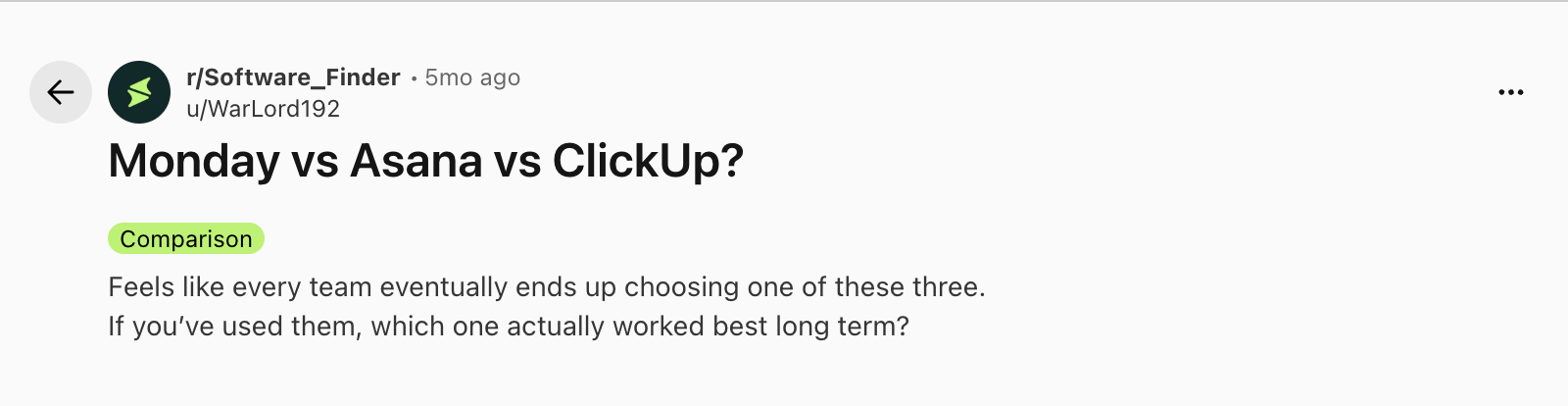 Those are exactly the kinds of conversations brands should pay attention to, and add their voices to.
4. Give creators and experts better source material
Once you know which topics and brand associations you want to strengthen, give creators, executives, SMEs, and social teams the information they need to talk about them clearly and consistently.
That might include:
- Creator briefs with the key topic and audience question
- Content outlines built around priority prompts
- Product facts and approved claims
- Specific use cases and customer examples
- Original research and statistics
- Competitive context
- SME talking points
- FAQs and common objections
- Links to deeper source material
- Clear guidance on what not to say
You don’t have to give everyone a script. But it’s helpful to provide a shared factual foundation they can interpret in their own voice.
For example, instead of telling a creator to say a product is “easy to use,” give them the onboarding flow, customer results, product demo access, and the specific features that reduce setup time. They can then test the claim, explain it naturally, and create a much more credible piece of content.
The same principle applies internally. A founder writing on LinkedIn, an SME appearing on a podcast, and a PR team pitching a reporter should all have access to the same core evidence, even if they communicate it differently.
5. Treat reviews and community feedback as content intelligence
You also don’t have to control the narrative. You can also pay attention to what customers and community members are saying naturally and in the wild, and then use those patterns to shape the rest of your marketing.
Look for:
- Common positive descriptions
- Recurring objections
- Unexpected use cases
- Competitors customers compare you with
- Questions people ask before purchasing
- Language customers use that differs from your brand language
Then feed those insights back into:
- Content
- Creator briefs
- Product pages
- FAQ pages
- Social
- PR
- Customer education
You can do that manually by monitoring reviews, comments, Reddit threads, and community conversations, or use a social listening platform to surface recurring themes at scale. Viral Nation’s SocialAI connects creator, content, community, commerce, and performance signals to inform decisions across its enterprise social services.
6. Measure GEO as an ongoing system, not a one-time campaign
GEO isn’t something you optimize once and move on from. The work is ongoing. As such, continually track how often your brand appears, which sources AI systems cite, how you compare with competitors, whether your positioning stays accurate, and whether AI visibility is driving traffic or conversions.
Repeat the same tests regularly, too. A 2026 review of GEO research found substantial run-to-run variability and low overlap in the sources different AI systems surfaced, which means checking a prompt once won’t tell you much about long-term visibility.
Treat GEO as an ongoing cycle of listening, measuring, adjusting, and coordinating across the teams shaping your brand’s presence online.
A coordination checklist for AI discovery
- Agree on the buyer questions, comparisons, and use cases the team will monitor.
- Record which brands and sources appear for those questions across the AI platforms being evaluated.
- Give content, creator, social, and communications teams the same approved facts and supporting evidence.
- Review customer and community conversations for recurring questions, objections, and product experiences.
- Use those findings to improve relevant content and briefs while preserving independent opinions.
- Repeat the checks and compare visibility, answer accuracy, referral activity, and business outcomes over time.
How Viral Nation connects social signals with GEO strategy
Viral Nation’s AI Discovery offering combines prompt and source mapping, content improvements, and ongoing measurement to help brands assess and improve their presence in AI answers. It starts by mapping prompts, citations, competitors, and current AI visibility to understand how a brand shows up and which sources are shaping those answers.
From there, Viral Nation combines owned content with creator authority, social proof, community signals, reviews, and earned media to strengthen the wider evidence around a brand. SocialAI™ adds another layer by analyzing creator, content, community, audience, commerce, performance, and safety signals to inform creator selection, content development, and ongoing GEO decisions.
Measurement closes the loop. Viral Nation tracks prompt visibility, share of voice, citations, AI referral traffic, and pipeline impact over time. In its AI Discovery launch announcement, Viral Nation reported results from applying the methodology to its own brand: 84% prompt visibility, 52% share of voice in mentions, 256% growth in AI referral traffic, and an additional $17 million in directly attributed pipeline.
These are company-reported results from Viral Nation’s own approximately 18-month test, not a forecast of client outcomes.
If you want to understand which social signals are shaping your brand’s AI visibility, Viral Nation can help you map the gaps and build a coordinated GEO strategy around them.
Frequently asked questions
How can social content contribute to AI discovery?
Creator reviews, community discussions, and expert posts can become sources that AI platforms cite when answering buyer questions. Their contribution varies by platform, topic, and prompt, so social activity alone does not guarantee visibility.
Which social platforms should a brand prioritize for GEO?
Start with the sources that appear in AI answers to your priority buyer questions. The studies discussed in this article show different citation patterns across platforms; use those findings as context, then examine your own category.
What should brands give creators and experts to support GEO?
Provide approved product facts, relevant examples, research, common buyer questions, and clear guidance on unsupported claims. Give creators and experts room to explain or test that information in their own voice.
How should brands measure AI visibility?
Repeat a consistent set of priority prompts and record brand mentions, cited sources, answer accuracy, and competitor presence. Track referral traffic and business outcomes alongside those observations, without assuming that a citation caused a conversion.