Adweek and Viral Nation joined forces for the first time to deliver a multi-hour, real-time broadcast during the Big Game—spotlighting the ads as they aired and the reactions they sparked.
The live commentary centered on a growing reality marketers are waking up to: The success of a Super Bowl ad isn’t the 30-second spot. It’s the momentum they build across every phase, including build-up, launch, amplification, and response.
From creator collabs and media blitzes to meme culture and first-party funnels, the best bets were long-game plays. During the four hours of live coverage, here’s what stood out the most.
The $20 Million Minimum
The price of admission for an ad slot is higher than ever. “Ten million for 30 seconds this year for the first time ever,” said Adweek’s Bill Bradley. That’s just for airtime. “You’re probably also paying another 10 million across the Olympics, NBA All-Star, and other NBC properties. It’s pretty pricey. It’s like 20 million if you’re doing 10 million for 30 seconds.”
And that’s also before celebrity fees, production costs, or distribution. “More brands than ever have come in for 60 seconds,” added Adweek’s Britney Kiefer. “So we’re looking at $20 million just as a baseline for some of them.”
That steep price tag is pushing brands to squeeze every drop of value from the buy, and that starts long before kickoff.
Pre-Game Press Junkets, Post-Game Punchlines
Viral Nation’s Culture Quotient data showed that 94% of advertisers pre-released full spots or teaser trailers this year, turning the Super Bowl into a multi-phase campaign rather than a single-night splash.
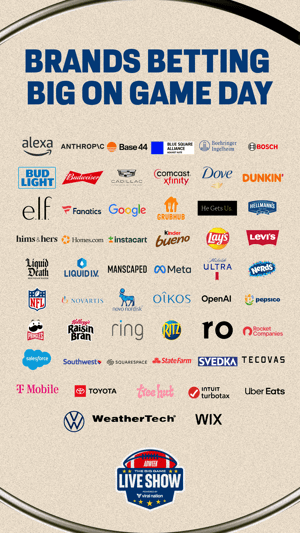
Some brands activated every touchpoint. For example, Liquid I.V. launched a 360 campaign with app integrations, DoorDash partnerships, and workplace activations for “National Rehydration Day.”
“We knew we had to have an incredible idea,” said Stacey Andrade-Wells, CMO of Liquid I.V. “We didn’t make the commitment to move into an official Super Bowl buy until we felt we had an idea that America would really resonate with.”
Uber Eats played the long game, too. “Momentum is built over years and over time,” said Georgie Jeffreys, head of marketing for Uber Eats in the U.S. and Canada. When a campaign starts to catch, she added, you have to strike while the iron’s hot.
Building Momentum
James Wood of Beers With Friends agreed that the standout campaigns focused on the long game. He explained the ultimate goal was “not just to buy attention, but to be a part of a shared cultural experience.”
“Cultivate a fandom for your brand and give people a way to participate with the brand storytelling,” he advised. And one way brands accomplished this was through thoughtful creator activations and social campaigns.
For example, Rocket Mortgage brought creators like Devon Rodriguez into the stadium to post in real time during their singalong ad. And Doritos tapped creators like Taylen Biggs to build pre-game hype for their Dinamita spot. Then, they extended the campaign through TikTok duets and snack rankings.
“Social is the place where culture gets made,” said Richelle Batuigas from Viral Nation’s Pulse Check team. “It’s where opinions are influenced. It’s where trends begin.”
“My biggest prediction is that some of the most creative moments we're going to see are not going to be in the ads themselves,” added Adweek’s Alison Weissbrot. “They're going to be on social media in the experiential in the halftime show.”
Some brands skipped TVC entirely and focused on social campaigns. “They’re really leaning into that second screen viewing,” said Adweek’s Chelsea Bakkan. They put all of their money into their social campaign. “I think it’s a really smart move,” she added.
Celebrity Overload (and Backlash)
Celebrities were also a topic of discussion for the participants. Many agreed that some spots leaned too hard on celebrity for celebrity’s sake. “If there's one ad with 20 celebrities, great,” said Bradley. “But when there’s 20 ads with 20 celebrities… not as great.”
Ritz’s spot drew particular criticism. “All amazing caliber talent,” said Weissbrot. “But there was no storyline, and they didn’t really make sense for the ad or the product. Waste of money, honestly.”
Heart, Humor, and Hairballs
The panel agreed that humor (often in absurd form) ruled the night. Singing toilets, anthropomorphic hairballs, and fiber jokes got more traction than the tearjerkers.
“Singing toilets. It’s where it’s at,” said Bradley. “You got to break through somehow. You got to do something different.”
Still, the best ads went for absurdity, mixed with brand clarity, over celebrity endorsement. “You can’t just plug in any celebrity,” he said. “Let it make sense. Give me a story. Give me a singing toilet. Give me a talking little hairball and I'm in.”
What’s Next
By night’s end, the Viral Nation Culture Quotient crown went to Kellogg’s Raisin Bran, driven by a Shatner-fueled blend of humor, nostalgia, and community management.
Ultimately, Viral Nation’s Brandon Lentino summed up the winning strategy. “You have to bring people into [your] storytelling early. Start the adventure well before the night of the Super Bowl so that you’re building the flame that you've already ignited by the time we get to the big night,” he said.
That’s the new playbook.

.png?width=300&height=300&name=July%20lists%20and%20blogs%20(1).png)