

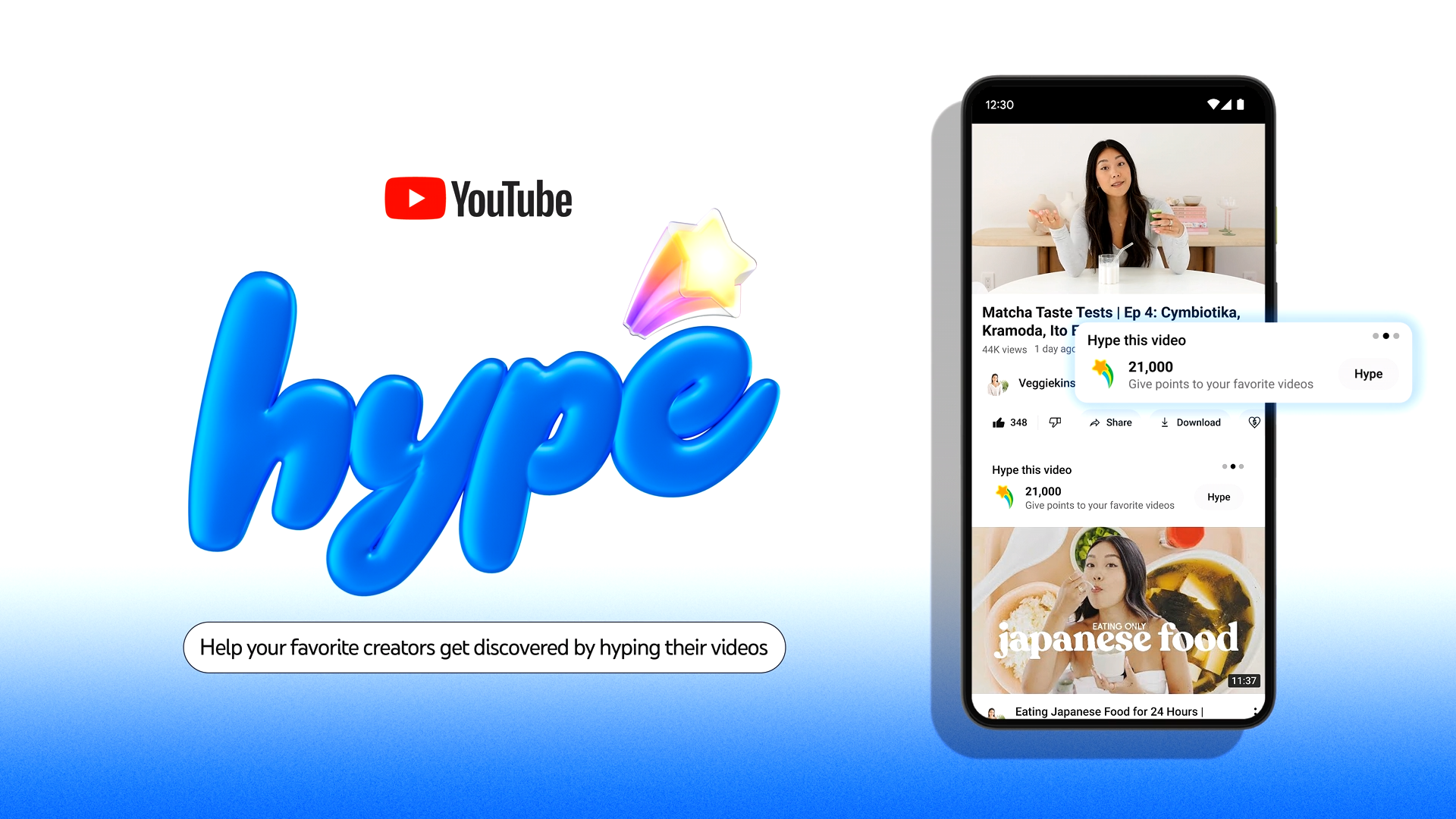
For years, follower counts were treated as the currency of influence. A million followers meant a big check, a bigger assumption of authority, and a guaranteed seat at the brand table. But YouTube’s latest move blows that model apart.
Hype, its new feature rolling out globally, puts amplification power in the hands of communities, not celebrity status. It elevates small creators who might never crack six figures in followers but hold what audiences actually trust: authenticity.
For CMOs, this isn’t just another platform update. It’s a flashing signal that the era of buying reach is ending and the era of buying relevance has begun.
What Is Hype And Why It Matters Now
At its core, Hype is a community-driven discovery tool.
Viewers can nominate creators they find valuable, and those creators then get surfaced to audiences outside their existing reach. Eligibility is capped at creators with fewer than 500,000 subscribers, giving small and mid-tier channels a clear pathway to visibility that was once reserved for the biggest names.
As YouTube’s own announcement put it, Hype is designed to give promising creators a shot at discovery, powered by their communities. In other words, it’s not just about how the algorithm views a creator’s content; it’s about how the community validates it.
This comes at a pivotal time as platforms are under pressure to deliver fairness and transparency. TikTok’s For You Page has set the standard for democratizing discovery, while Instagram continues to tweak its Explore and Reels algorithms to keep up. For YouTube, Hype offers a differentiated angle: pairing algorithmic distribution with human nominations to surface creators who are credible and community-endorsed.
For brands, this means there’s a new on-ramp to discovering creators whose audiences trust them deeply and now have the potential to break out at scale.
The Shift From Follower Counts To Platform-Native Amplification
For over a decade, follower counts have been the industry’s shorthand for influence. Early brand partnerships were priced on reach: a million followers meant a high fee, regardless of engagement or relevance. But over time, that equation has broken down.
- Engagement rates decline as audiences grow. Influencers with 10,000–100,000 followers have an average like rate of 3.8%, compared to just 1.2% for those with more than a million followers.
- Costs have inflated, with some macro creators charging over $ 20,000 per post for declining returns.
- Audiences themselves have grown wary, often perceiving macro influencers as polished spokespeople rather than authentic voices.
Hype signals the next stage in this evolution: influence isn’t earned by follower accumulation, but granted through platform amplification. TikTok’s For You Page has already proved that a creator could go viral with zero followers. Instagram Reels showed that the algorithm could make anyone a star overnight. Twitch raids demonstrated the power of community-to-community lift.
Now, YouTube has formalized this into its ecosystem, institutionalizing discoverability for creators who may never crack a million followers but who can move audiences in meaningful ways.
Why YouTube Is Betting On Smaller Creators
The bet on smaller creators is rooted in both cultural and commercial realities.
Over the past decade, the influencer economy has matured from a wild west of follower-chasing to a structured ecosystem with tiers, metrics, and budgets that rival traditional media. But as the space has scaled, cracks have formed. Mega influencers have become expensive to the point of diminishing returns. Audiences are savvy to overly polished endorsements. And younger generations increasingly demand voices that feel like peers, not spokespeople.
Platforms have noticed.
TikTok rewrote the rules by showing how quickly an unknown creator could capture mass attention. Instagram leaned into short-form discovery through Reels. Twitch made community amplification a native behavior. For YouTube, Hype is the clearest acknowledgment yet that influence is shifting away from celebrity status and toward relatability and relevance.
That shift is being driven by four core dynamics:
- Consumers crave authenticity. Gen Z and Gen Alpha audiences increasingly reject overly produced influencer content. They gravitate toward smaller creators who feel more like peers than celebrities.
- Trust dynamics are shifting. Data shows 77% of consumers have bought, trusted, or talked about a brand because of an influencer in the past six months. Smaller creators are more likely to drive these behaviors because they occupy niches where trust is more deeply established.
- Economic efficiency. Campaigns featuring nano- and micro-influencers deliver up to 10× ROI compared to macro campaigns, according to Marketing Dive. Smaller creators deliver higher engagement at a fraction of the cost.
- Platform competition. YouTube is still battling TikTok for cultural dominance, particularly among younger audiences. Elevating emerging talent through Hype is YouTube’s way of reinforcing its relevance in a creator-first world.
Greg Isenberg, CEO of Late Checkout, highlights the value this update brings to smaller creators: “It's not about killing the big creators. It's about giving the underdogs a chance to be seen.”
What This Means For CMOs And Brand Strategy
For CMOs, the implications are clear: follower counts are no longer a reliable benchmark for influence. The new equation is authenticity + amplification. But understanding the shift is only the first step because the bigger challenge is translating it into action.
For years, influencer strategy has centered on consolidating spend at the top, locking in macro creators with the largest reach and assuming that efficiency would follow.
However, as platforms like YouTube rewire discoverability through tools like Hype, those assumptions begin to break down. Reach is no longer owned; it’s distributed. And the brands that succeed will be the ones that recognize this shift early and adapt their approach accordingly.
That means:
- Diversify your mix. Stop concentrating budgets on a handful of celebrity talent. Instead, build scalable networks of micro- and mid-tier creators who can spark relevance across multiple communities. This isn’t just about cost savings; it’s about reach through breadth, not just depth.
- Shift your KPIs. Impressions and follower counts no longer accurately reflect the true impact. Start tracking resonance (does the message resonate?), conversions (does it drive action?), and cultural participation (does the brand appear in the right conversations?).
- Budget smarter. A macro-only strategy can drain resources and limit experimentation. Micro creators allow for more test-and-learn campaigns, faster iteration, and ultimately higher aggregate ROI.
The trend is already underway: 44% of marketers plan to increase creator budgets, with an average increase of 25%. Much of that new spend is being directed toward mid- and micro-level talent, where performance data is strongest.
For CMOs, the risk isn’t whether to shift budgets, but how efficiently to do so. Those who delay will pay premiums for macro creators, while competitors scale their influence more efficiently across emerging voices.
The Risks Of Ignoring The Micro-Creator Era
Every platform shift creates winners and losers. The winners are the brands that move early, recalibrate quickly, and build relationships with emerging talent before the rest of the market catches on. The losers are those who cling to old playbooks and pour budgets into strategies that platforms themselves are quietly deprioritizing.
The micro-creator era is no different. By overlooking this shift, brands not only miss out on efficiency but also risk irrelevance. YouTube is telling the industry, loudly, that the future of influence lies with smaller creators. Ignoring that signal creates three major risks:
- Underperformance. Macro-only campaigns will struggle as follower-based reach loses traction. Platform algorithms increasingly favor discovery and amplification over static audiences, meaning the ROI on large creator partnerships will continue to decline.
- Cultural irrelevance. Many of the most important trends now originate with micro creators—memes, product discoveries, and cultural conversations often start at the edges, not the center. Brands that aren’t plugged into these communities risk being absent when new cultural moments are born.
- Overpaying for devalued metrics. Follower counts are being systematically devalued as a measure of influence. Brands that continue paying premium rates for “big numbers” are effectively investing in a currency that platforms themselves no longer recognize as valuable.
Competitors who adapt now will capture the upside, locking in authentic partnerships and benefitting from algorithm-driven amplification, while slower-moving brands will be stuck paying more for less. In the creator economy, timing is everything, and hesitation is costly.
How To Recalibrate Your Influencer Playbook
Recognizing the shift is one thing, but acting on it is another.
For CMOs, the challenge isn’t simply swapping out a few macro influencers for micro talent. It’s about redesigning the entire influencer playbook around a new set of assumptions: reach is no longer bought, it’s distributed; trust is no longer a byproduct, it’s the currency.
Staying ahead requires moving from awareness to action. Here are four steps every brand should take:
- Audit your creator mix. Start by quantifying how much of your budget is locked into macro creators. If 70–80% of spend is tied to the top of the pyramid, you’re overexposed. Diversification doesn’t mean abandoning big names altogether; it means rebalancing your portfolio so micro- and mid-tier voices can deliver scale through breadth and authenticity.
- Leverage Hype as a discovery tool. Treat YouTube’s new feature as more than a signal; it’s an actionable resource. By tracking which creators are rising through Hype, brands can identify talent before their costs spike and build long-term partnerships early. Think of it as cultural due diligence: identify who your audiences are naturally elevating and get there first.
- Reframe your KPIs. Traditional metrics, such as impressions and follower counts, no longer capture what matters. Instead, measure discovery (how many new audiences are being reached), authenticity (is the content credible and aligned?), and conversions (are audiences acting?). These metrics reflect actual influence, not just visibility.
- Partner strategically. The micro-creator era can feel overwhelming; there are simply too many voices for a single brand team to evaluate. This is where agencies and trusted partners add value, offering scale in identifying, vetting, and activating talent networks without diluting authenticity.
For CMOs, this isn’t just a shift in tactics but a shift in mindset, from buying reach to buying relevance.
From Reach To Relevance
YouTube’s Hype feature is more than a product update. It’s a clear signal about where influence is headed: smaller, more authentic, and increasingly amplified by platforms.
A brand’s next billion views won’t come from influencers with seven-figure follower counts. They’ll come from creators whose communities trust them, and who now have platforms giving them the amplification they deserve.
The micro-creator era isn’t coming; it’s already here.

.png?width=300&height=300&name=July%20lists%20and%20blogs%20(1).png)

.png?width=300&height=300&name=May%20lists%20and%20blogs%20(19).png)