

- Anthropic pop-up drives AI buzz
-
Tech goes experiential for trust
-
Cultural collabs boost credibility
-
Shareable merch fuels awareness
-
Creators key to AI adoption
Tech goes experiential for trust
Cultural collabs boost credibility
Shareable merch fuels awareness
Creators key to AI adoption
.png)
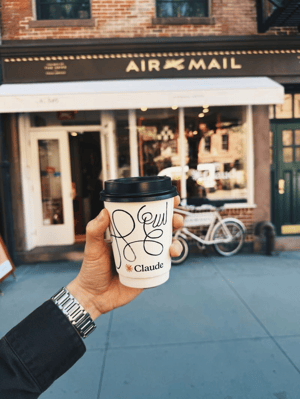
On an unseasonably warm October Saturday in New York's West Village, hundreds of people lined up down the block for free coffee and a baseball cap that said “thinking.”
The host was Anthropic, the AI company behind Claude.
Over the course of seven days, Anthropic's pop-up at the Air Mail newsstand drew more than 5,000 visitors. They left with tote bags, postcards, and matchbooks designed by the company's in-house illustrator, as well as copies of CEO Dario Amodei's essay, "Machines of Loving Grace," printed on 100% post-consumer recycled paper and bound in navy cloth.
By the final day, the caps and essays were gone, but the space was still packed.
“New York City is the capital of the world and therefore the top domino to go after in consumer marketing,” Friend.com CEO Avi Schiffman told MarketWatch after his own AI wearable brand faced subway ad vandalism earlier this year.
Anthropic clearly got the memo. But this was more than a marketing stunt; a signal of something bigger. AI companies are finally learning to play the brand game, and they're borrowing tactics straight from the influencer marketing playbook.
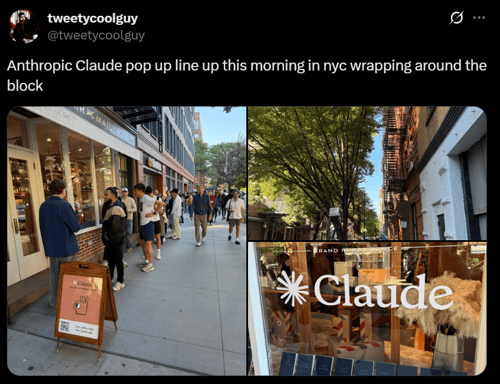
Anthropic's pop-up is part of a broader shift in how technology companies are approaching consumer attention.
Claude, according to Sam McAllister, a member of staff at Anthropic, is “built to help people think through their hardest problems. We don't need to distract them with anything else.”
In a market saturated with AI tools that promise to automate everything, Anthropic is carving out a different lane: the thinking person's AI. Not replacing human effort, augmenting it. And to communicate that message, they needed more than ads; they needed a vibe.
Enter the pop-up: a format that's equal parts retail theater, content opportunity, and brand world-building. DTC brands, streetwear labels, and beauty companies have perfected the strategy. Now, AI is catching up.
The reason is simple. Wall Street currently views AI primarily as a consumer product, not a business application, according to Bryan Wong, portfolio manager at Osterweis Capital Management.
Enterprise adoption has been limited beyond coding and customer support. The path to large-scale profits from business applications will be "gradual," said Jordan Klein, an analyst at Mizuho Securities. As a result, investors expect most models to incorporate some form of consumer-facing strategy, whether that's ad placement or brand awareness plays like this one.
Translation: AI companies need to win over everyday users, not just CTOs. And that means thinking like a lifestyle brand.
Anthropic was deliberate about where they showed up. They partnered with Air Mail, the digital magazine founded by Graydon Carter, a former editor of Vanity Fair.
In 2023, Carter opened a physical newsstand in Manhattan's West Village, a brick-and-mortar outpost that doubles as a curated cultural space. The location has become known for its “brand-in-residence” program, where select brands take over the space for limited runs.
Previous residents have included luxury names like Bottega Veneta and Ralph Lauren—not exactly the typical company for an AI startup. But that's precisely the point. By placing Claude in that context, Anthropic was signaling taste, positioning itself alongside legacy luxury brands, and borrowing the cultural authority that comes with that curation.
The space itself, small, well-designed, with a back patio perfect for lingering, created an intimate environment that felt more like a boutique book launch than a tech demo. Not a flashy activation in Times Square. The choice communicated Anthropic's brand positioning before anyone even walked through the door.
Here's what else worked:
Free coffee, caps, and printed essays gave people something to hold, wear, and share. Social media flooded with posts of people showing off their “thinking caps.” One user wrote, “An aesthetically iconic campaign from @AnthropicAI that convinced me (and several others!) to line up in the West Village on a Saturday morning.”
The caps were understated enough to wear unironically, the essay was substantial enough to feel like a gift, and the coffee cups became Instagram props. Every item was designed with shareability in mind, which meant the campaign's reach extended far beyond the 5,000 people who physically showed up.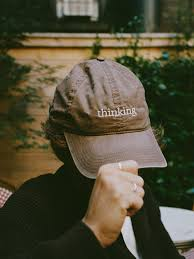 .
. 
The pop-up wasn't trying to be thoughtful rather than cool. The design was understated, the messaging philosophical. There were no neon signs or crypto vibes, no hustle-culture slogans or founder worship. Instead, the space felt like a place where ideas mattered. That distinction matters in a city like New York, where AI skepticism runs high and brands are constantly fighting for attention in an oversaturated market.
Compare this to Friend.com's subway ads, which were met with anti-AI vandalism. The difference is, Anthropic wasn’t pushy. Instead, they created an inviting space people wanted to be in.
The visuals were clean, merch was minimal, and the location was Instagrammable. The result? Organic social buzz that extended far beyond the initial footfall.
Posts ranged from people flexing their caps to longer reflections on what the campaign represented. “We're seeing a dichotomy: do we want to leverage AI to enhance 'thinking' or further sap our attention? The decision is ours,” one person wrote.
This is the kind of integrated, creator-friendly activation that CMOs should be paying attention to.
Every person who walked away with a tote bag or a cap became a brand ambassador. Instagram posts extended the campaign's reach. And every piece of user-generated content reinforced Anthropic's positioning as the thoughtful alternative in a noisy AI landscape.
Anthropic's partnership with Air Mail is a perfect example of cross-vertical collaboration, and this trend is only going to accelerate. AI companies don't need to build brand worlds from scratch. They need long-term partnerships with existing tastemakers, publications, and cultural institutions to borrow credibility and reach new audiences.
This isn't new for consumer brands. We've seen Glossier pop up at Sephora, Supreme collaborate with Louis Vuitton, and A24 partner with streetwear brands. But for tech companies, especially those in AI, it's a relatively fresh move. And it works because it sidesteps the biggest challenge AI brands face: trust.
Air Mail, with its carefully cultivated aesthetic and editorial reputation, offered something more valuable than foot traffic: credibility by association.
As Lia Haberman, creator economy expert, said: “Everyone’s rushing to automate everything with AI right now, but there's a real pushback happening. People are tired of algorithms telling them what to buy. They want recommendations from actual humans they trust.”
The same logic applies to other verticals. Imagine an AI company partnering with a bookstore to host author talks powered by Claude's research capabilities. Or collaborating with a design studio to showcase how AI augments creative work. Or working with a university to create student-facing workshops that demystify the technology.
These partnerships work because they meet people where they already are, not where tech companies think they should be. And they open up opportunities for brands to partner with influencers in ways that feel native, not forced.
A design influencer hosting a workshop at a Claude pop-up doesn't feel like an ad. A finance creator breaking down how they use AI in their workflow at a brand residency feels like value-add education rather than sponsored content.
Anthropic's pop-up succeeded because it prioritized experience over conversion. People showed up because the moment felt worth participating in.
The next wave of AI marketing will be about partnering with influencers and creators to humanize the tech. AI companies are starting to realize this too. We're already seeing tech founders become influencers themselves.
Sam Altman doesn't just run OpenAI. He's become a lightning rod for AI discourse, with his congressional testimony clips going viral and his tweets driving news cycles. When he was briefly ousted then reinstated as OpenAI's CEO in November 2023, it dominated tech Twitter for days and spawned countless memes.
But the real unlock isn't just founder-led content. Partner with creators who can translate complex capabilities into relatable use cases. Show people how Claude helps a designer think through a creative brief. How it helps a writer structure a long-form piece. How it helps a founder draft a pitch deck. How it helps a teacher create lesson plans or a lawyer research case law.
That's proof of value. And it's the kind of social-first storytelling that traditional ads can't deliver.
Consider how beauty brands have leveraged influencers for years. They don't just send products and hope for posts. They create affiliate programs, seeding strategies, exclusive access, and co-creation opportunities. AI brands need to adopt the same playbook. That means:
The brands that crack this will be the ones that move from awareness to adoption at scale because trust doesn't come from a 30-second ad. It comes from watching someone you respect use a tool and explain why it matters.
Anthropic's pop-up signals something bigger than a single activation. Tech companies are finally taking brand building seriously, and they're willing to invest in the kind of cultural fluency that's long been the domain of fashion, beauty, and lifestyle brands.
It's not enough to build a better model. You have to build a brand people want to be associated with, create moments people want to participate in, and tell stories people want to share.
Increasingly, that means borrowing from the playbook of influencer marketing, experiential retail, and cultural partnerships. It means treating brand-building as a strategic imperative, not a nice-to-have.
For marketing leaders, this is both an opportunity and a challenge. The opportunity is that the tactics that work for AI brands will work for yours too—regardless of industry. The challenge is that the bar for creativity, cultural fluency, and execution is higher than ever.
Anthropic's pop-up was a case study in how tech companies can compete for cultural relevance in an increasingly crowded market. It proved that even the most complex technology can be communicated through design, experience, and community.
Brands need to stop asking if experiential and influencer marketing are necessary. The better question: can you compete without them, especially as AI rewrites the rules of consumer engagement?
In 2026, the brands that break through are those that have earned trust, created culture, and made people feel seen. Because when everything else can be automated, connection is the only moat that matters.

.png?width=300&height=300&name=July%20lists%20and%20blogs%20(1).png)
.png?width=300&height=300&name=May%20lists%20and%20blogs%20(19).png)