

.jpg)
Welcome to the fifth edition of Decoded!
Your Next Biggest Brand Competitor Might Be a YouTuber
We know that brands aren't just competing with other brands anymore. They're competing with creators who have become businesses with built-in distribution, near-zero customer acquisition costs, and content engines that can launch a product harder than a Super Bowl spot ever could.
MrBeast (Jimmy Donaldson) is the cleanest case study: a creator who turned algorithmic mastery into a multi-venture enterprise whose chocolate brand, Feastables, is now competing for shelf space and share of stomach against legacy confection giants.
And yet the "competitor" framing tells only half the story. Traditional brands are already working with creator-led enterprises, just without the right structure, expectations, or governance. Starbucks didn't run a creator collab. It took a starring role inside Beast Games and extended that partnership into stores with a limited-time drink. Jack Link's didn't do an influencer post. It built a co-branded product line with MrBeast, distributed nationally, and became an official sponsor of Beast Games Season 2.
The real question, category by category, is whether you should compete, collaborate, invest, or supply. MrBeast is the blueprint for what happens when attention turns into ownership, and for brands, the playbook has shifted from paid media to partnership architecture.
Creators Have Structural Advantages Brands Can't Buy Their Way Out Of
Let's name the core anxiety brands aren't saying out loud: creator-led enterprises are operating with structural advantages that old-world brand building can't quickly replicate.
The market is expanding fast. Goldman Sachs Research projected the creator economy could grow from roughly $250B to $480B by 2027, driven largely by influencer marketing and platform payouts. The more important detail sits underneath that headline: Goldman also notes that brand deals remain the main revenue source for creators (roughly 70%, based on survey data). The default brand mindset has been "we pay creators."
MrBeast, along with a handful of creator-led enterprises, is where that logic breaks.
Once a creator can convert attention into product economics, brands face a competitor with hundreds of millions of followers and culturally native distribution. A competitor that treats content as the top of funnel, the brand story, and the conversion engine simultaneously. A competitor that can run campaigns every week because content is the business model.
This is why Feastables shouldn't be treated as a merch line. It's a CPG company born from a content engine. In Bloomberg-reported investor documents, Feastables generated about $250M in sales and $20M+ in profit in 2024, while the media business produced similar sales but lost money due to production costs. The product line is becoming the cash engine.
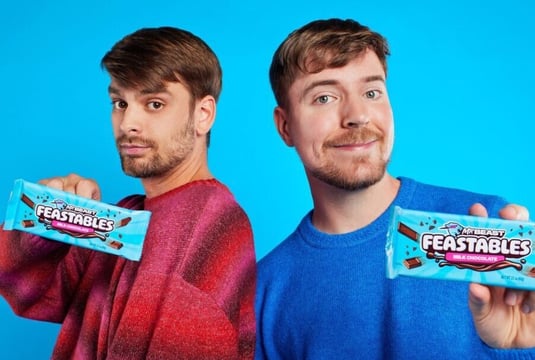
That dynamic (content as customer acquisition, product as margin) is exactly what legacy brands are nervous about. Because in many categories (snacks, beverages, cosmetics, apparel, toys), the biggest cost is attention. Creators like MrBeast already own it.
MrBeast: How a YouTuber Became a Category Threat and Why That Matters for Marketers
MrBeast's story is often told as spectacle: bigger stunts, bigger prizes, bigger production. Marketers should read it differently. His trajectory is the evolution from attention arbitrage to enterprise leverage.
He started publishing on YouTube in 2012, then spent years tinkering inside the algorithm until his viral moments became repeatable systems. By June 2024, he overtook T-Series to become YouTube's most-subscribed channel at ~269M subscribers, with his biggest-ever daily subscriber spike exceeding 2M that same day.
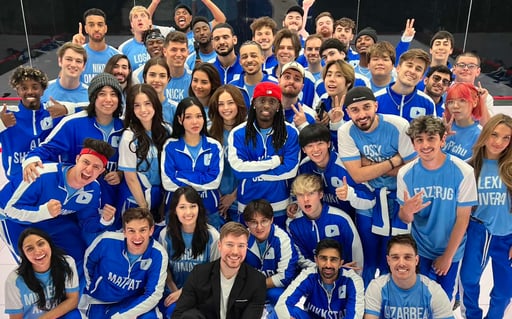
Fast-forward to early 2026 and the scale becomes hard to comprehend. MrBeast's main YouTube channel sat at 468,720,290 subscribers on Feb 24, 2026, and 469,589,566 subscribers on Mar 1, 2026. Total channel views are reported at over 113 billion.
Zoom into why Feastables is the scary part for brands: it turns that attention into repeat purchase behavior. The content creates demand. The product captures margin. The product then becomes content again through giveaways, sweepstakes, and participation mechanics. Feastables ran a Beast Games sweepstakes where buying bars at participating retailers (Walmart, Target, 7-Eleven, Kroger, Sam's Club, Albertsons) created entries with a chance to win contestant spots on Beast Games Season 2. A closed-loop attention-to-commerce flywheel.
Creator-led enterprises don't just market. They build behavioral systems and turn products into participation.
The institutional ambition is just as significant. The Guardian reported MrBeast exploring fundraising that could value his business empire at roughly $5B, building a holding company structure around media, food brands, and other ventures. The Verge's reporting echoes the same thesis: investors are betting the future of Beast's business is physical products, with Feastables potentially exceeding the core video business.
For marketers, the takeaway is direct: creator-led enterprises are becoming competitors because they can turn marketing into margin.
The Collaboration Is Already Happening. Brands Just Aren't Structuring It Right.
If you only see MrBeast as a competitor, you're ignoring the most important evidence already in the market. Collaboration models are being built in real time.
MrBeast is simultaneously a competitor, a media property, a distribution partner, and a commercial collaborator. Brands are buying into creator IP the way they used to buy into networks.
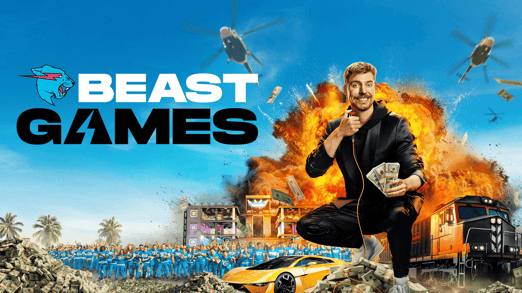
Amazon is the clearest example. Beast Games became Prime Video's most-watched unscripted series ever, with Amazon reporting 50M viewers in the first 25 days and a #1 ranking in more than 80 countries. This is a new kind of brand-aligned distribution deal where a creator's format becomes premium entertainment IP.
Then layer in the next step: brands integrating into the IP rather than advertising around it.
EMARKETER reported Starbucks sponsoring Beast Games Season 2 with a visible on-set presence in "Beast City," including beverage and food access for contestants, surprise prizes, and an in-store limited-time "Cannon Ball Drink" tied to the show. Starbucks embedded itself inside a creator-owned entertainment ecosystem and extended that integration to retail. Creator marketing has evolved from campaign execution into distribution strategy.
Brands are co-building products with creators, not just sponsoring them.
Jack Link's is the best example of a legacy brand choosing partnership. Jack Link's announced an official sponsorship of Beast Games Season 2, positioned as an extension of the "Jack Link's x MrBeast lineup" of beef sticks, distributed nationally through Amazon, Walmart, Target, and 7-Eleven, with a sweepstakes mechanic tied to purchasing through their Amazon brand store.
The strategic implication goes beyond performing well in the snack aisle. Co-branded creator product lines allow legacy brands to acquire something they've struggled to manufacture organically: cultural attention with conversion attached.
Institutions are treating creator-led brands as tier-one sponsors.
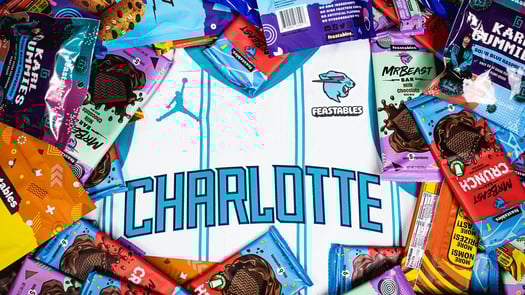
Feastables has also earned legitimacy outside the snack category. Axios reported that the Charlotte Hornets signed Feastables as an official jersey patch partner, including collaborative digital media and marketing opportunities. Whatever the long-term arc of that partnership, the signal is clear: major sports institutions are willing to treat a creator-led brand as an anchor tenant.
Even supply chain partnerships are strategic.
 Feastables joining Tony's Open Chain (Tony's Chocolonely's supply-chain initiative) signals something different: not ad-driven, but industry-structure-driven. Feastables positioned itself as the first major US chocolate brand to join the initiative as part of a long-term ethical sourcing strategy. Creator-led enterprises are learning how to borrow and integrate institutional credibility through supply chain standards and governance.
On the philanthropy side, the scale is equally significant. TeamSeas, in partnership with Ocean Conservancy, removed 34,080,191 pounds of trash and raised $30M with 1.3B views across tagged videos. TeamWater reached a $40M goal in partnership with WaterAid, targeting clean water for 2 million people. Brands can participate in this kind of collaboration, but only if they treat creator partnerships as multi-year platforms rather than one-off activations.
Stop Fearing the Creator Conglomerate. Start Architecting Around It.
The strategic question has moved past "should we partner with creators." The new question is how brands partner with creator-led enterprises without becoming the party paying for reach while the creator builds the category.
Decide what you're actually buying.
Brands get burned when they approach creator-led enterprises the way they approach media channels. These are bundles: media plus distribution plus audience trust plus product behavior plus narrative IP. MrBeast's CEO has explicitly framed the future as moving away from one-off partnerships toward multi-year exclusive advertising deals, because structured, sustained attention compounds in value. That's the cue for brands: the unit of investment is rights, exclusivity, and integration.
Pick the collaboration model that matches your competitive reality.
When a creator-led enterprise enters your category, four options exist:
Supply them. Become the best-in-class partner behind the scenes: manufacturing, ingredients, packaging, distribution, retail activation, logistics. You may trade some margin for volume and long-term relevance.
Co-build with them. Jack Link's shows how legacy brands can co-create product lines where the creator's audience becomes customer acquisition and the brand's supply chain becomes an operational advantage.
Buy into their IP. Starbucks embedded into the entertainment ecosystem and extended to retail with a product tie-in. That's the model.
Invest early. In categories where a creator-led enterprise is likely to become a dominant challenger, minority investment or strategic partnership is often cheaper than competing against a brand with a built-in audience later.
Treating creator-led enterprises as neither real competition nor real partners is the losing position.
Creator-led enterprises like MrBeast have already solved the hardest problem in modern marketing: sustained, owned attention. The brands that win will be the ones that figured out how to plug into ecosystems that already convert culture into commerce at scale.
If this one got you thinking, check out our other Decoded editions — we broke down how Gap is navigating its brand reinvention and what Snapchat's pivot actually means for marketers.

.png?width=300&height=300&name=July%20lists%20and%20blogs%20(1).png)

.png?width=300&height=300&name=May%20lists%20and%20blogs%20(19).png)