

.png)
As brands pump out more content, audiences are craving someone worth following. And the next wave of influence is coming from… inside the company’s own walls.
Forward-thinking DTC and B2B brands are developing internal influencers: people with genuine industry authority and a point of view that attracts a community.
Think Laura Erdem at Dreamdata sharing the real sales grind, Dara Treseder at Autodesk blending brand storytelling with leadership insights, or Alina Vandenberghe at Chili Piper opening up conversations about tech, leadership, and inclusion. Their expertise builds trust, and that trust pulls people toward the brand.
To learn more about internal influencers, I sat down with Ashley Faus, Director of Integrated Product Marketing at Atlassian, who literally wrote the book on human-centered marketing.
She shared with me how internal influencers differ from ambassadors and employee advocates, what makes internal influencers credible, and how brands can start building programs that earn attention through expertise rather than volume.

What is an internal influencer?
When Faus thinks about internal influencers, she starts from her broader thought leadership framework. “I’m basically scoring them on my four pillars of thought leadership, credibility, profile, being prolific, and depth of ideas,” she explains. Both internal and external influencers are held to that bar: “Both have strong credibility with their audience. Both have strong and recognizable personal brands, and both create and share content consistently.”
The key distinction, she says, is that “internal influencers actually work for the company. And it is not the same as an employee advocate or an amplification program.” Most employee amplification programs, she points out, “are usually… trying to push the company message.”
Internal influencers, by contrast, “have a strong brand on their own,” Faus says. “They’ve built this big following. They’re industry leaders. Yes, they do share some brand content, but it’s not the entire core of their content mix the way that… evangelists are.”
Their credibility doesn’t come from their employer. It comes from who they are. “True internal influencers are the ICP,” Faus emphasizes. “One of the reasons marketers can’t really be internal influencers for, say, developer marketing is because we don’t have credibility with the audience. You really can’t have that [credibility] unless you are the audience.”
That lived experience is what makes audiences trust them. “[Internal influencers] experience the problems, they talk about the solutions that they’re using, and then they’ve got that halo of the brand behind them,” she says. “It’s not just them shilling for the company. It’s also them talking about problems in their space.”
Internal influencers are practitioners first and employees second. They’re people who bring genuine industry authority and a recognizable personal brand that strengthens the company they represent.
What makes a strong internal influencer
Faus scores influencers on four pillars of thought leadership: credibility, profile, being prolific, and depth of ideas.
Strong internal influencers tend to have:
- Shared values with the company
- A genuine passion for creating and engaging
- Credibility within the industry or ICP
- The ability to produce and distribute content consistently
“Oftentimes marketing will say, ‘Oh, we need somebody to be the face of the brand,’ and they’ll try to choose an executive,” she says. “But if they actually are terrible at speaking, they’re slow at writing, they hate being on LinkedIn or on social media. They’re probably not gonna be the right folks. Internal influencers already have that audience and brand alignment.”
They’re also usually great at one or two channels rather than trying to be everywhere. “They tend to be strong in only one or maybe two channels,” Faus notes. “Laura [Erdem, from Dreamdata], in her case, is primarily strong on LinkedIn, and then she has started to do some speaking gigs.”
Case in point: Dreamdata’s Laura Erdem
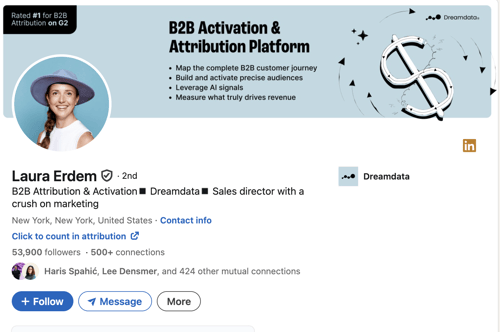
Faus points to Laura Erdem, US Sales Director at Dreamdata, as a standout internal influencer.
“She’s been a seller for like 10, 15, 20 years,” Faus says. “She’s got a huge personal brand [and] almost 50,000 followers on LinkedIn.”
Erdem’s influence works because she is the ICP. “I can’t speak to sellers the way that she can because she is a seller,” Faus says. “When she talks about trying to do deep dives into her deals, when she talks about the Q4 push, when she talks about understanding her accounts and key contacts and she uses Dreamdata to showcase how she looks at that. That’s very different than how I, as a marketer, do that.”
Erdem’s content mix demonstrates the ideal balance: demos, sales insights, and thought leadership tied to real experience. “You don’t get this kind of engagement just because you work for the company and you share company-related content,” says Faus.
How to balance the voice of the individual and the brand
The right balance between personal and brand content depends on the company.
“If you get somebody that’s like 90 percent brand and only 10 percent personal, then they’re basically not acting as an internal influencer. They’re kind of just acting as a spokesperson for the brand,” Faus says. “If they’re 90 percent personal and only 10 percent brand, then they’re really leaning more into the personal brand.”
She points to a few companies handling this balance well, including:
- Dreamdata, where multiple leaders share content under their own names, creating a collective halo.
- Chili Piper, where co-founder Alina Vandenberghe blends company content with reflections on leadership and being a woman in tech.
- Autodesk, where Dara Treseder leans more heavily on brand storytelling and awareness.
Each example reflects a spectrum: from company-led to personality-driven, with the best results usually somewhere in the 40–60% range of personal-to-brand focus.
How to start and grow an internal influencer program
Building an internal influencer program takes more than appointing spokespeople.
Faus advises starting by identifying employees who already have visibility and interest in creating content. “It’s really hard to completely start from scratch,” she says. “So give space to these people, give encouragement to them, and give the brand halo.”
That means supporting them with design, speaking opportunities, and amplification. “If the brand has lots of followers on their company pages, engage on that person’s content, send them for speaking gigs, and pitch them for media,” she suggests.
Another common pitfall is focusing only on executives. “Because they’re so far removed from the work, it’s actually really hard for them to continue to have credibility,” Faus notes. “They also tend to err more on the side of salesy content because they’re like, ‘I’m the CIO or the CMO. I need to sell the company.’”
Instead, brands should find credible voices across roles and seniority levels, especially those who already create content their peers value. “Giving the halo of the brand to me, for example, would look like helping secure additional speaking engagements, assigning design resources to elevate the look and feel of the brand,” Faus says.
Moving forward: The rise of creator-style roles
Faus predicts more companies will begin hiring creator-style roles within their organizations, but with mixed results. “I do think we’ll see more brands building creator-style roles internally,” she says. “The interesting thing is that right now, those primarily sit in evangelist-type roles.”
In tech, for example, evangelists like those at Atlassian focus heavily on product content. Faus notes that their work is “probably 80–90% brand instead of more of that 40–60% brand versus personal.”
As the creator economy expands, she expects that ratio to change. “We’re starting to see a shift,” Faus says. “Having folks who are good on camera, who can edit, who can write… if they have not built that audience, and they’re just using their skills on behalf of the brand, they’re not actually building that credibility.”
Some people see the distinctions between evangelists, creators, and internal influencers as minor. Faus disagrees. “It actually does matter in large part because it changes the metrics and it changes the audience that people go after.”
For her, the ultimate goal is credibility that compounds over time. “It’s a tough balance to strike,” she says, “but when you find people who are credible in the industry (not just corporate spokespeople) you build influence that outlasts any campaign.”

.png?width=300&height=300&name=July%20lists%20and%20blogs%20(1).png)

.png?width=300&height=300&name=May%20lists%20and%20blogs%20(19).png)